
From real job applications
Do tailored resumes actually work? Reframing, yes. Fabrication, never.
 Soheil Nasirian
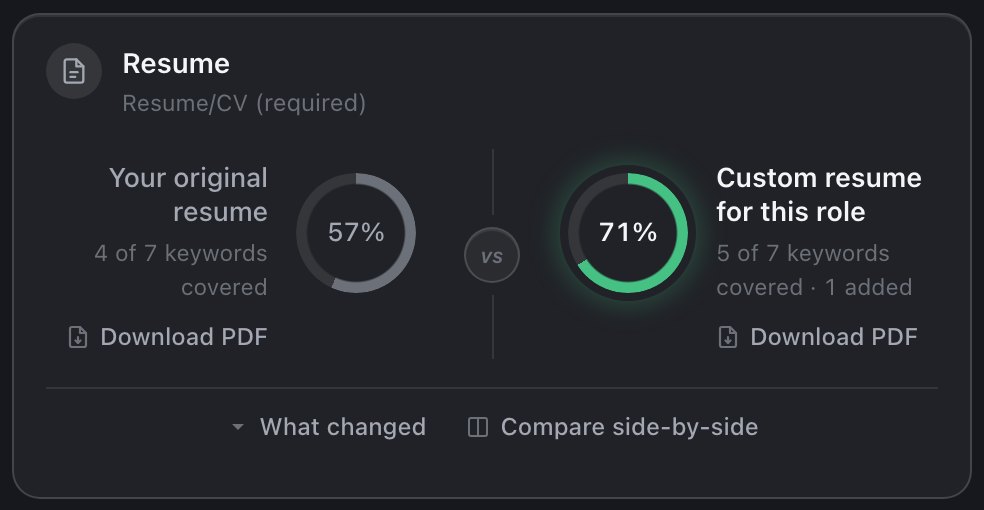
Does tailoring your resume actually work? Yes, if it means saying what's true in the ad's words. Across the real applications we looked at, tailoring raised the share of a job ad's terms the resume covered from 46% to 70%. Almost none of that was new. A quarter of what ads asked for was already true of the person, just not written down. The rest was never added, because it wasn't true.
In short
- 46% → 70%of an ad's terms covered, before and after tailoring
- 1 in 4terms an ad asks for were true of the applicant, but missing from the resume
- 3 in 10terms were not true, and were left out on purpose
"Tailor your resume to the job description" is probably the most repeated advice in job searching, and it rarely comes with an explanation of what tailoring is or where it should stop. Building Sherpa, we had to decide both, and we ended up with one rule.
Reframing is needed. Fabrication is rejected.
Reframing is needed
Most resumes undersell the person. The work is there, described in the words of the team that did it: "ran experiments on the checkout" where the ad says "A/B testing", "worked with the platform team" where it says "API products". A recruiter skimming a pile of resumes, or an applicant tracking system matching resume keywords, reads past it.
That middle row is what tailoring is for. Nearly a quarter of what an ad asks for is something the applicant has done but never described in those words. Writing it down, in the bullet where it happened, is still the truth, and now a reader can find it.
Data: real applications tailored against live job ads up to 26 September 2026, counted only in aggregate: each term an ad asked for, whether the original resume mentioned it, whether it was true of the applicant according to everything they had told Sherpa, and whether the tailored resume mentioned it. The rows overlap slightly, so they add up to a little over 100%.
Fabrication is rejected
The last row stays open. Nearly every ad asks for something the applicant doesn't have, like a domain they've never worked in, a tool they've never used, or more years than they have. A resume that covered 100% of an ad would be a resume that says something false, and the first interview question about it ends the process.
That's where tailoring ends and lying on a resume begins. Moving a true fact into the ad's words is tailoring. Adding a tool, a domain or a year you don't have because the ad asked for it is lying.
Reframed, and kept
- "Ran experiments on checkout" becomes "A/B testing on checkout", because it was.
- A payments platform other teams built on is described as an API product, because it was one.
- The bullet the ad cares about moves to the top of the role.
Invented, and refused
- A tool the ad names that appears nowhere in your record.
- An industry you have not worked in, written as if you had.
- A number, a title or a year you did not have.
Sherpa checks for this every time. Before an application reaches you, a quality check reads it against the ad and against everything you've told Sherpa. Every tool, acronym, name and skill it adds has to trace back to your resume or your answers. A draft that adds one that does not is refused and written again. The check binds only what Sherpa writes: when you edit your own documents, what you write is yours.
Data: the same applications: about three in ten of an ad's terms were not true of the applicant, and almost every application had at least one term left out for that reason.
How to tailor your resume to a job description by hand
- List the ad's terms: every skill, tool, domain and kind of work, in its own words.
- Sort each one into three columns: on my resume, true but not on my resume, not true.
- Rewrite for the middle column only, in the bullet where you did the work.
- Leave the last column off, and prepare an honest answer for it: what you have that is closest, and how you would close the gap.
- Keep one master resume and a copy per application, so each new application starts from your real resume.
A resume tailored to every job, without a single invented line
Sherpa is an AI job search assistant. It tailors your resume and your answers to each job description from your real experience, shows you the original and the tailored version side by side with how much of the ad each covers, and refuses anything your record doesn't support.
Start for freeof an ad's terms covered after tailoring, up from 46%